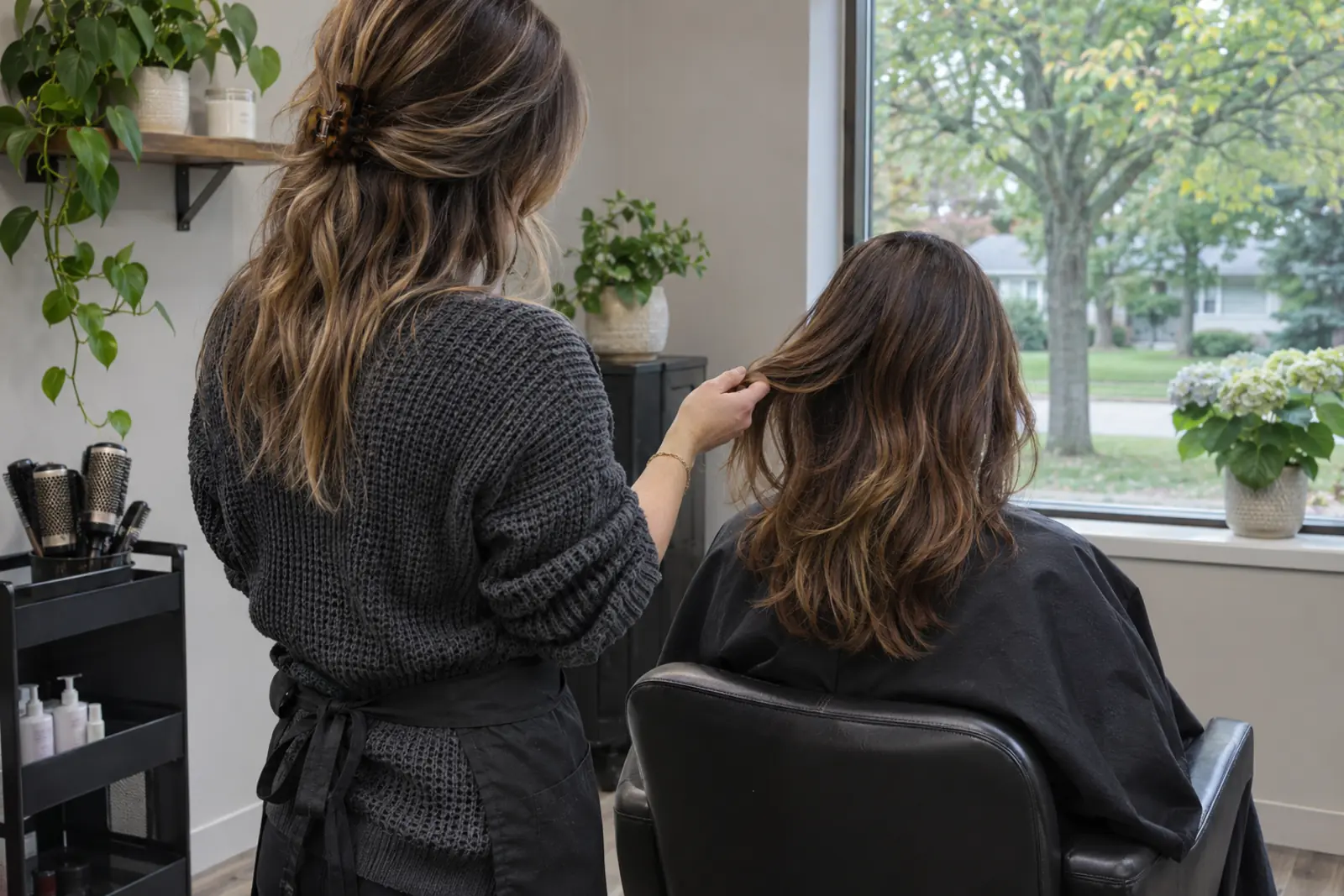
The relationship between a client and their hairdresser is one of the more quietly important ones in ordinary life. A great match can last years, even decades. A poor one can mean months of growing out a cut you never wanted, or watching an expensive color fade in three weeks because the technique was wrong for your hair. Finding the right stylist is not a matter of luck - it is a matter of knowing what to look for before you ever sit in the chair.
This guide works through the full process: how to define what you actually need, where to find credible leads, how to evaluate a portfolio intelligently, what to expect from a first consultation, and how to recognize when it is time to look elsewhere. It is written for anyone searching for a hairdresser in Algonquin, Lake in the Hills, Crystal Lake, or the broader McHenry County area - though the principles apply anywhere.
What Makes a Stylist the Right Fit for You
No single stylist is right for every client. The best match depends on your specific hair type, the services you use most, and how you communicate under pressure. Getting clear on those three things before you start searching saves a lot of time.
Hair type and texture experience
Cosmetology training covers a broad range of hair types, but hands-on experience varies considerably from one stylist to the next. Someone who works daily with fine, straight hair may not have equivalent depth with coily, high-porosity, or textured hair - and vice versa. Before booking, it is worth confirming that the stylist regularly works with your hair's density, texture, and natural pattern.
This distinction matters most for:
- Type 3 and Type 4 (curly and coily) hair, which requires specific cutting and styling methods such as the Deva cut or the curl-by-curl technique
- Very fine or low-density hair, which responds differently to layering, chemical services, and color than thicker strands
- Color-treated or chemically processed hair, where a stylist needs to understand porosity and structural integrity before recommending further services
- Hair that has been heat-damaged, over-bleached, or is in active transition - growing out color, reverting to natural texture, or recovering from a previous chemical process
Service specialization
Most salons employ stylists with general skills across cuts, color, and chemical services. Over time, however, most stylists naturally develop deeper expertise in one or two areas. If color work is your priority - balayage, dimensional highlights, vivid color, or correction work - look for someone whose portfolio reflects that focus. If a precision haircut is what you care about most, seek a stylist known for cuts rather than color. Trying to find one person who excels equally at both is possible but narrows the pool considerably.
The Algonquin area and broader McHenry County has a range of salon environments, from full-service day spas to boutique color studios to independent suite renters operating inside larger suite complexes. Each setting tends to attract stylists with different areas of emphasis. A day spa environment often draws stylists who handle a full service menu across all categories, while a dedicated color-focused salon tends to attract specialists. Neither is inherently better - it depends on what you need.
Personality and communication style
Chemistry matters more than most people admit when choosing a stylist. Some clients want someone with strong creative opinions who will push them toward something new. Others want a collaborator who listens closely and executes precisely what was discussed. Neither preference is wrong, but a mismatch creates frustration on both sides, often silently, until the client stops returning without explanation.
During any first interaction or consultation, notice whether the stylist asks questions before offering suggestions. That ordering - assessment before recommendation - is usually a reliable signal of their overall working style.
Where to Build Your Shortlist
Before committing to anyone, build a list of three to five candidates. Here is where the most reliable leads come from.
Personal referrals from people with similar hair
The highest-quality lead is a referral from someone whose hair genuinely impressed you. If you notice a great cut or color on a friend, colleague, or even a stranger, ask who did it. Personal referrals are more useful than online reviews because you can see the actual result in real daylight, observe how well it has held up over time, and ask specific questions about the experience from someone you trust.
When asking for a referral, be specific about what you admired. If you loved the dimensional color, ask whether that stylist specializes in color. If the haircut still looked precise six weeks later, ask how long they have been seeing that stylist. Those details help you understand whether the referral fits your specific needs or just the referring person's.
Instagram and TikTok portfolios
Most working stylists maintain an active portfolio on Instagram or TikTok. These platforms are genuinely useful for pre-screening because they show real client work, often with helpful context. When searching, use location-specific hashtags such as #AlgonquinILhair, #McHenryCountySalon, or #ChicagoSuburbsHair. Browsing tagged locations at local salons can also surface individual stylists who may not rank well in general Google searches.
What to look for in a social portfolio:
- Consistency across different clients and hair types, not just one photogenic result repeated with variations
- Posts that show color at multiple stages - fresh, grown-out, and refreshed - rather than only day-of photographs
- Realistic before images paired with afters; stylists who show the starting point tend to be more transparent about what is achievable
- Recency - a portfolio with nothing newer than two years may not reflect current technique or product knowledge
Google Maps and review platforms
Searching "hair stylist near me" or "hairdresser near me in Algonquin" on Google Maps surfaces salons and stylists with photo uploads, written reviews, and rating distributions over time. Pay less attention to the overall star average and more attention to what the reviews actually describe. Phrases like "she asked what had not worked before and adjusted accordingly," "my color finally held past six weeks," or "she talked me out of a bad idea and was completely right" are more useful signals than a string of five-star ratings with no detail.
Platforms like StyleSeat and Vagaro let individual stylists maintain detailed profiles with service menus, pricing ranges, and photo galleries. These are worth checking in addition to Google, particularly for finding independent stylists who rent suites rather than working inside a larger salon - a category that includes many of the most experienced stylists in the northwest Chicago suburbs.
The salon's own staff pages
If a salon lists its stylists with individual bios, those bios often reveal specializations, years of experience, and continuing education credentials. Advanced education from brands like Redken, Wella, Schwarzkopf, or Goldwell indicates a stylist who invests in keeping technique current with evolving product systems. Certifications in Deva Curl, Olaplex, or Keratin Complex point to specific service expertise that may matter for your hair type or goals.
For a broader overview of what to look for in a salon environment before choosing an individual stylist, the guide to how to choose a salon and day spa covers facility-level criteria including licensing, cleanliness standards, and service range.
Reading a Stylist's Work Before You Commit
Seeing a portfolio is not the same as knowing how to evaluate one. A few specific things are worth looking at carefully.
Diversity of results versus a single signature look
Some stylists develop a signature style - a particular balayage placement, a favorite cut silhouette, or a go-to color family - and that can be a strength if your goal aligns with it. The concern is when a portfolio shows only one type of result repeatedly, regardless of the client. That pattern can mean the stylist steers clients toward what they prefer to do rather than what suits the individual. Look for variety: different face shapes, starting colors, lengths, and textures across the portfolio clients.
Color accuracy in photographs
Salon lighting is designed to make hair look beautiful, which is not dishonest but does make portfolio photographs harder to evaluate accurately. Warm-toned salon lighting softens everything; cool-toned lighting can make color appear ashier than it is. When possible, look for photos taken in natural daylight or outdoors, where color renders most accurately. Watch for extreme warm or cool color casts in the image - heavy orange or blue tints may be editing that masks what the color actually looks like in everyday conditions.
Looking for the week-two result
A skilled blowout on day one of a new cut can photograph beautifully even when the underlying cut is imprecise. Look for photos taken at least a week or two after the initial service, when the blowout effect has worn off and the natural shape of the cut is visible in the client's everyday hair. Stylists who post "week two" or "grown out" follow-up content tend to be more confident in the technical quality of their work, not just the styling.
Evidence of returning clients
If a stylist shares posts of returning clients - someone coming back for a gloss refresh, a trim, or a full seasonal color update - that is evidence the client trusted the result enough to continue the relationship. High client retention is one of the strongest signals in any service business, and a portfolio that includes long-term client journeys tells you more than a gallery of one-time transformations.
What a Good Consultation Should Feel Like
A consultation is an assessment, not a sales pitch. Whether it happens before an appointment, at the beginning of one, or as a separate pre-booked session, a skilled stylist uses it to gather information before making recommendations - not to confirm decisions they have already made.
What the stylist should ask first
A thorough stylist will ask about your hair history before touching your head. That history should cover recent chemical services - color, relaxers, perms, keratin treatments - as well as current products, wash frequency, heat tool habits, and how much time you realistically spend on styling at home. That last point matters more than many clients expect. A look that requires 45 minutes of daily maintenance is not a good result for someone who allots 10 minutes to their hair.
The most useful question a stylist can ask is what has not worked before and why. A stylist who asks about previous failures is trying to avoid repeating them. One who skips that question and dives straight into recommendations may be prioritizing speed over accuracy - or may simply be more interested in what they want to create than in what will actually serve you.
Physical assessment before recommendation
Before suggesting a cut or color approach, a skilled stylist will physically handle your hair to assess density, porosity, and elasticity. These qualities are not visible in an inspiration photo and directly affect what is achievable. A stylist who touches your hair and then adjusts their recommendation based on what they feel is demonstrating technical competence - and honesty - rather than just pattern-matching your inspiration image to a service.
Porosity is worth understanding as a client. It describes how readily your hair absorbs and releases moisture and color. High-porosity hair - often the result of repeated bleaching or heat damage - lifts and fades color faster than low-porosity hair and may require a different formula approach or additional conditioning treatment. If your stylist mentions porosity or elasticity during a consultation, that is a good sign they are thinking about your specific hair rather than a standard protocol.
Honest expectation setting
The most valuable thing a consultation can do is calibrate expectations accurately. If you bring an inspiration image, an experienced stylist will tell you which elements are achievable in one visit, which require multiple sessions, and which may not be possible for your hair in its current condition. They will tell you if the person in your inspiration photo appears to be wearing extensions, if the image has been heavily edited, or if the lighting makes the color look different than it would in everyday conditions.
A stylist who promises to achieve anything in a single session - especially dramatic color corrections or bleach on heavily colored or damaged hair - without discussing hair integrity is not being honest with you. That honesty, when you receive it, is not a limitation being placed on you; it is professionalism that protects your hair and your money.
For color services specifically, understanding the technical differences between approaches before agreeing to them makes the consultation more productive. The comparison of balayage versus highlights explains what each technique involves, how they behave over time, and what maintenance each requires - useful context to have before sitting down with a new colorist.
Questions to Ask at Your First Appointment
Walking in with a few prepared questions - even if you only ask them mentally as a framework - helps you assess whether this stylist is the right long-term match.
About experience with your specific hair type or concern
"Do you work with a lot of clients who have [fine / coily / heavily color-treated / transitioning] hair?" is a reasonable and direct question. Listen for specificity in the answer. A stylist who says "yes, I specialize in curly hair and I use the curl-by-curl cutting method" gives you actionable information. One who says "oh sure, I work with all kinds of hair" without further detail tells you less than you need.
About process and realistic timeline
If your goal involves a significant change - going from dark to blonde, correcting a previous color job, adding extensions, or reversing chemical damage - ask how many sessions the process will realistically take. Ask what the hair might look like in between sessions. This is not a test of the stylist's confidence; it is practical planning that helps you budget your time and money and avoids the frustration of expecting one result and experiencing another.
About home maintenance
Ask what you should be doing between visits to maintain the result. A thorough stylist will address wash frequency, water temperature, the type of products best suited to your service, and when to come back for a refresh or trim. If the guidance is vague or entirely absent, the result may fade or shift faster than it should - and you may find yourself returning sooner than expected without understanding why.
About pricing before the service starts
Pricing should always be discussed before the service begins. It is entirely appropriate to ask for a price range when booking, and to confirm that range at the start of the appointment. Most salons price by the stylist's level, with senior or master stylists commanding higher rates that reflect their experience and training. Some charge by time, some by service category, and some add costs based on hair length or the amount of product used in a color service. Asking explicitly whether a quote is a flat rate or an estimate prevents unpleasant surprises at checkout.
Red Flags That Are Worth Acting On
Not every warning sign indicates incompetence. Some indicate a poor fit. Others indicate a genuine problem worth addressing promptly.
Skipping the consultation entirely
A stylist who begins cutting or applying color without asking about your hair history or current condition is skipping a step that exists for good reason. Processing damaged hair without assessing its integrity can cause breakage or color failure. Even in a busy salon environment, a one-to-two minute verbal check-in before a service begins is standard professional practice.
Dismissing your questions or concerns
Clients are allowed to ask questions, verify pricing, and raise concerns about how a service is going. A stylist who becomes defensive, dismissive, or visibly impatient when you do any of these things is showing you a communication dynamic that will only become more difficult over time. This is worth noting even if the technical result is acceptable.
Overselling services you did not request
There is a meaningful difference between a stylist recommending a treatment because your hair genuinely needs it and a stylist pushing add-ons aggressively during every visit. Informed recommendations are part of good service. Pressure is not. If you consistently feel sold to rather than advised, trust that instinct.
Inconsistent results between visits
Consistency across appointments is a marker of technical skill. If your haircut looks noticeably different depending on which day you book, or if your color consistently fades unevenly or in unexpected tones, something in the execution is off. One disappointing visit can be an off day. A pattern across multiple visits is a different problem - and one worth raising directly before concluding the fit is wrong.
Sanitation concerns
Clean tools, freshly laundered or single-use capes, disinfected stations, covered product containers, and clean mixing bowls are baseline professional standards in any licensed salon in Illinois. If the workspace appears unsanitary, that is a non-negotiable signal to look elsewhere. The spa and salon etiquette guide covers what a professional environment looks like across different salon and spa settings, and what clients have a right to expect.
Consistent late starts with no acknowledgment
Running behind occasionally is a reality in any appointment-based service business. The professional response is a brief acknowledgment and an apology. If being kept waiting is treated as simply how things work - with no recognition that your time was affected - that reflects the overall tone of how the relationship will be managed.
When It Is Time to Find Someone New
Finding a stylist you trust is a real investment of time and money, and switching can feel disloyal. But staying with someone out of inertia rather than genuine satisfaction is not loyalty - it is avoidance. There are specific situations where looking elsewhere is the right decision.
After multiple corrective visits for the same issue
If the same problem has been addressed two or three times without a lasting fix - uneven fade, an imprecise perimeter, color that consistently pulls warm or brassy in the same section - it may be a technique issue rather than a product or timing variable. This is worth raising directly with the stylist first. If the conversation goes poorly, or the problem continues after the conversation, a second opinion from a different stylist is the logical next step.
When your hair goals have significantly changed
A stylist who excels at precision cuts may not be the right person for a full-color transformation requiring advanced bleach work. Someone who built their reputation on creative vivid color may not be as engaged with the kind of low-maintenance single-process color you now want. Changing stylists because your priorities have shifted is not disloyal - it is matching the right specialist to your current goal. The best stylists understand this and will often refer clients to colleagues whose strengths are a better fit.
When communication has quietly broken down
Over time, a stylist-client relationship can settle into comfortable shorthand, which is generally a good thing. What is not good is finding yourself unable to raise a concern, ask for a change, or admit that a result was not what you wanted. If you have started leaving appointments and fixing things yourself at home rather than mentioning them in the chair, something has gone wrong. That silence usually grows rather than resolves itself.
When the price-to-result ratio has shifted
Prices increase over time. Experienced stylists charge more as they build their reputation and book out further, and that reflects genuine market value. But if prices have increased significantly while the results, service experience, or communication quality have stayed flat or declined, the equation has shifted. Recognizing that is not being difficult - it is making a reasonable assessment of an ongoing service relationship.
How to handle the transition
There is no professional or social obligation to explain your departure to a previous stylist. If you feel comfortable offering a brief explanation - "I am trying a different approach to my color and want to work with a specialist" - that is a generous choice but entirely optional. What is not required is an apology, a detailed explanation, or any interaction at all. Simply booking elsewhere is enough. Most experienced stylists have been both the stylist someone left and the stylist someone found, and they understand how the cycle works.
Frequently Asked Questions
How do I find a good hair stylist near me in Algonquin or the surrounding area?
Start with personal referrals from people whose hair you genuinely admire, then search Google Maps for stylists in Algonquin, Lake in the Hills, or Crystal Lake with photos and recent reviews. Instagram searches using hashtags like #AlgonquinILhair or #McHenryCountySalon can surface individual stylists whose portfolios you can study before making contact. Platforms like StyleSeat and Vagaro also list independent stylists in the northwest Chicago suburbs with detailed service menus and pricing ranges.
What should I bring to my first appointment with a new stylist?
Bring two or three inspiration images that reflect your actual goal - not just a color or cut you admire in isolation, but results that seem realistic for your hair type and daily routine. Having your hair history ready also helps: recent chemical services, the products you currently use, and anything that has not worked well in the past. The more specific the information you bring, the more accurate and honest the recommendation you will receive.
How can I tell whether a stylist has experience with my hair type?
Review their social media portfolio for clients who share your hair texture, density, and color history. If every client in the gallery has fine, straight hair and yours is thick and coily, that matters. You can also ask directly - a stylist with genuine expertise in your hair type will name specific techniques or advanced certifications, like the Deva cut method for curly hair, rather than offering general reassurance that they handle everything.
Is a hair consultation always free?
Policies vary by salon and stylist. Many offer a brief complimentary consultation - in person, by phone, or by video - before the first appointment. Some charge a fee for complex color corrections or major transformations, which is often applied toward the service cost if you proceed. It is always appropriate to ask upfront about consultation costs when you first contact the salon or stylist.
What is the difference between a licensed cosmetologist and a hair stylist in Illinois?
In Illinois, the professional license is a cosmetology license, issued by the Illinois Department of Financial and Professional Regulation (IDFPR). It covers cutting, coloring, chemical services, and other hair treatments. "Hair stylist" is a job title, not a separate credential. All practicing stylists in licensed Illinois salons are required to hold a valid cosmetology license. You can verify an individual's license status through the IDFPR's online license lookup tool - confirm the current URL directly at idfpr.illinois.gov, as lookup page addresses change periodically.
How long should I give a new stylist before deciding whether the fit is right?
One appointment is enough to evaluate communication style, consultation quality, and professionalism, but may not be enough to judge long-term results. For color, the six-to-eight-week mark reveals how well it holds and fades evenly. For cuts, the two-week point is more reliable than day one, once the initial blowout has settled and the natural shape is visible. If the first visit was promising but imperfect, a second appointment with specific feedback is worth trying before making a final decision to look elsewhere.